
Free delivery options available!

Aluminium Composite Panels (ACP Sheets & Boards)

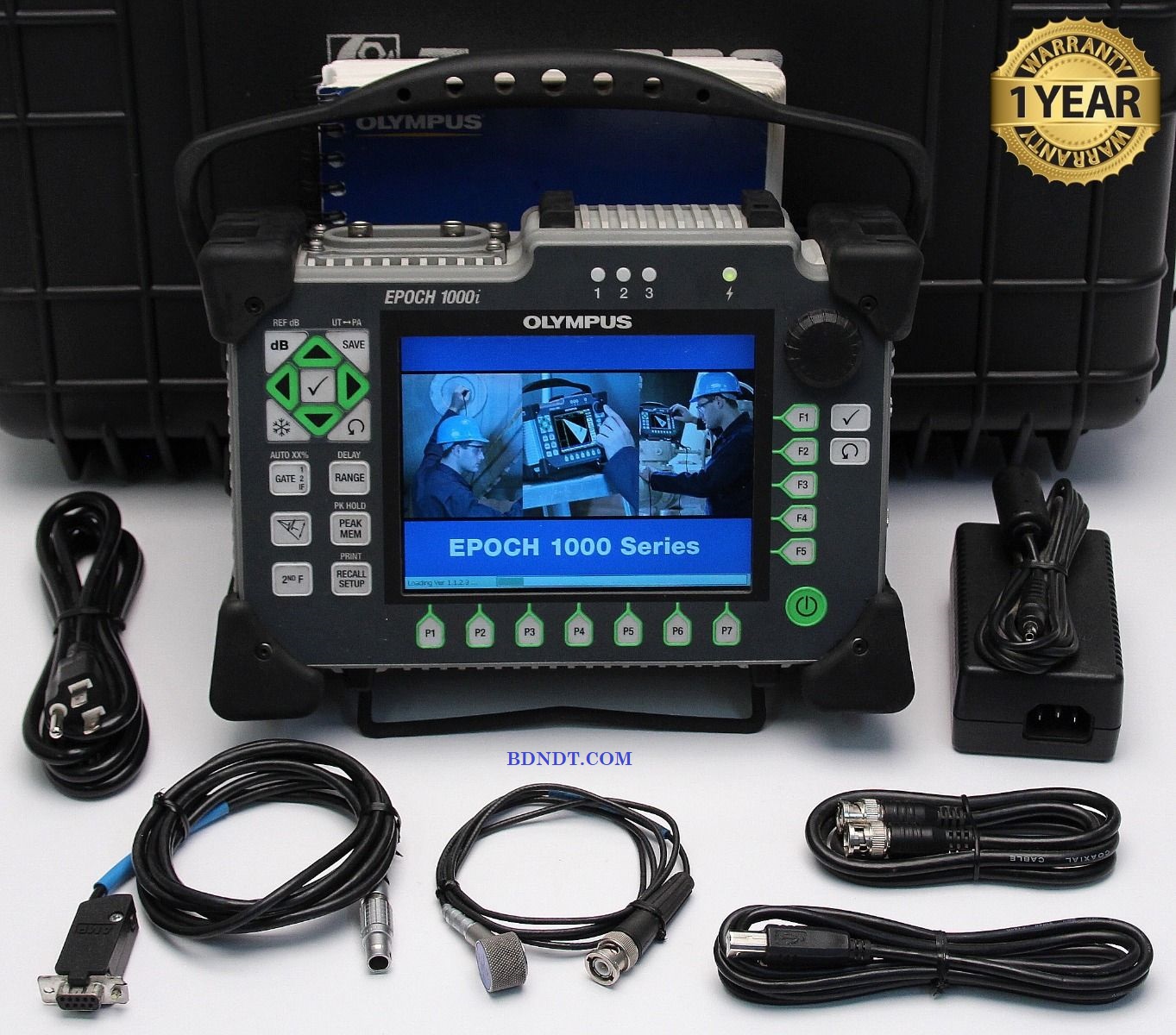
Olympus Epoch 1000i Ultrasonic Phased Array Flaw Detector Price in BD

$ 95.82

New!
Olympus Epoch 1000i Ultrasonic Flaw Detector Upgradeable to Phased Array The EPOCH® 1000, EPOCH 1000iR, and EPOCH 1000i provide advanced conventional ultrasound capabilities for both basic and advanced level users. These portable instruments can also be integrated into small systems for high-speed scanning and single-channel imaging and come standard with a host of high-performance features, including a 6 kHz maximum Pulse Repetition Frequency (PRF) with single-shot measurements for accurate high-speed scanning applications, tunable square wave pulser with PerfectSquare™ technology, and comprehensive digital filter sets for exceptional signal-to-noise clarity. Features: Adjustable pulse repetition frequency (PRF): 5 Hz to 6 kHz Single-shot measurements in all standard modes Tunable square wave pulser with PerfectSquare™ technology Programmable analog and alarm outputs Over 30 digital filter sets Digital high dynamic range receiver EPOCH 1000 Advanced UT The EPOCH® 1000 is an advanced conventional ultrasonic flaw detector that can be upgraded with phased array imaging at an authorized Olympus service center. EPOCH 1000 iR Advanced UT Phased Array Ready The EPOCH 1000 iR provides the same ultrasonic flaw detection capabilities as the EPOCH 1000 with the benefit of upgrading to phased array with simple field-remote activation. EPOCH 1000 i Advanced UT Phased Array Built-in The EPOCH 1000 i comes standard with the same advanced ultrasonic flaw detection capabilities as the EPOCH 1000, with the addition of a built-in phased array imaging package.   Full Specifications: General Specifications Overall dimensions: (W x H x D) 252 mm × 177 mm × 107 mm (9.92 in. × 6.97 in. × 4.2 in.) Keypad: English, International, Japanese, Chinese Languages: English, Spanish, French, German, Japanese, Chinese, Russian, Italian, Polish Transducer connections BNC or Number 1 LEMO Data storage :Onboard up to 10,000 IDs with waveform, standard 4 GB compact flash card (removable) Battery type: Single lithium-ion rechargeable standard Battery life: 8 hours (conventional UT mode); 7 hours (phased array mode) Power requirements :AC Mains: 100 VAC to 120 VAC, 200 VAC to 240 VAC, 50 Hz to 60 Hz Standby mode :Adjustable from 15 minutes to 120 minutes with 50% less battery consumption Display type: Full VGA (640 × 480 pixels) Transflective Color LCD, 60 Hz update rate Display dimensions (W x H, Diag.): 132.5 mm × 99.4 mm, 165.1 mm (5.2 in. × 3.9 in., 6.5 in.) Inputs/Outputs USB ports: 1 USB Client, 3 USB Host ports RS-232: Yes Video output: VGA output standard Analog output: 4 analog outputs, Selectable 1V/10V Full Scale, 4 mA max Alarm output: 6 alarm outputs, 5V TTL, 10 mA Trigger I/O: Trigger input 5V TTL; trigger output, 5 V TTL, 10 mA Encoder inputs 2-axis encoder line (quadrature) Environmental Ratings IP rating: Designed to meet requirements of IP66 Explosive atmosphere: Tested to MIL-STD-810F, Method 511.4, Procedure 1. Atmosphere defined per NFPA 70, Article 500 as Class I, Division 2, Group D. Shock tested: IEC 600689-2-27, 60 g’s, 6 µsec Half-Sine, 18 Axes total Vibration tested: Sine vibration, IEC 60068-2-6, 5 Hz to 150 Hz @ 0.03 in. or 2 g’s Displacement Amplitude, 20 sweep cycles Operating temperature: –10 °C to 50 °C (14 °F to 122 °F) Battery Storage temperature: –20 °C to 60 °C (–4 °F to 140 °F) Battery Recharge temperature: 0 °C to 40 °C (32 °F to 104 °F) Pulser Pulser type: Tunable Square Wave PRF: 5 Hz to 6,000 Hz in 5 Hz increments Energy settings 50 V to 475 V in 25 V increments Pulse width: Adjustable from 45 ns to 5,000 ns (0.1 MHz) with PerfectSquare Technology Damping 50 Ω, 100 Ω, 200 Ω, 400 Ω Pulser delay: Not applicable Receiver Gain: 0 to 110 dB Maximum input signal: 20 Vp-p Receiver input impedance: 400 Ω ± 5% Receiver bandwidth: 0.2 MHz to 26.5 MHz @ –3 dB Receiver delay NA Digital filter settings Standard filter set (EN12668-1 Test & Compliant): 7 filters Advanced filter set (not tested to EN12668-1): 30 filters Rectification: Full wave, positive half wave, negative half wave, RF Reject: 0 to 80% FSH with visual warning Amplitude measurement: 0% to 110% full-screen height with 0.25% resolution Measurement rate: Equivalent to PRF in all modes Calibration Automated calibration • Velocity, Zero Offset • Straight Beam (first back wall or echo-to-echo) • Angle Beam (Soundpath or Depth) Test modes: Pulse Echo, Dual, or Through Transmission Units: Millimeters, inches, or microseconds Range: 3.33 mm to 26,808 mm (0.131 in. to 1054.1 in.) at 5900 m/s (0.2320 in./µs) Velocity: 635 to 15, 240 m/s (0.0250 to 0.6000 in./µs) Zero offset: 0 µs to 750 µs Display delay: –59 mm to 25,400 mm (–2.323 in. to 1000 in.) Refracted angle 0° to 85° in 0.1° increments Gates Measurement gates: Two fully independent gates for amplitude and time-of-flight measurements Measurement mode: Soundpath Interface gate: Optional, with Gate 1 and Gate 2 tracking Gate start: Variable over entire displayed range Gate width: Variable from gate start to end of displayed range Gate height: Variable from 2% to 95% full-screen height Alarms • Positive and negative threshold • Minimum depth Reference cursors: Two reference cursors for A-scans Measurements Displayed measurement: Six locations available (manual or auto selection) Gate 1: Thickness, soundpath, projection, depth, amplitude, time-of-flight, min./max. depth, min./max. amplitude Gate 2: Same as Gate 1 IF gate (Optional): Thickness Echo-to-Echo: Standard. Choose between Gate2-1, Gate2-IF, and Gate1-IF Other measurements: Overshoot (dB) value for DGS/AVG, ERS (equivalent reflector size) for DGS/AVG, AWS D1.1/D1.5 rating (D), reject value DAC/TVG: Standard DAC points: Up to 50 points, 110 dB dynamic range Special DAC modes: 20% to 80% DAC, Custom DAC (up to 6 curves) TVG table: Up to 50 points, 110 dB dynamic range, compatible with IF Gate at all PRF settings Curved surface correction: Standard. Tube or bar OD correction for angle beam measurements Weight: 3.67 kg (8.1 lb), including lithium-ion battery   Download Product Datasheet Olympus Epoch 1000i
Category:

Aluminium composite panels (ACP) are lightweight, rigid sheets made from two aluminium layers bonded to a polyethylene or mineral-filled core. Also known as aluminium composite board or aluminium composite material, these panels are widely used for signage, displays, cladding, and architectural applications due to their strength, durability, and smooth surface finish.

diamondcutrugs supplies high-quality aluminium composite panels in multiple sizes, thicknesses, and finishes. Easy to cut, route, and fabricate, ACP sheets are ideal for professional sign makers and commercial projects requiring a long-lasting and visually clean material.

Aluminium Composite Panels: Premium ACM Solutions for Australian Projects

If you’ve been in the construction industry for a while, you have likely hit that wall where a client wants something that photographs well, does not cost a lot, and will not warp in Australia after a summer or two.

Sheet aluminium costs a fortune and bends with heat. Acrylic is prone to scratching. Dibond works, but the colour range can be quite limiting.

This is where aluminium composite panels or aluminium composite boards really shine.

  • The material stays flat without fussing.
  • They cut clean on a CNC or guillotine.
  • They survive Melbourne weather without turning into a warped mess.

.. which is more than you can say for half the materials out there.

But not every ACP is built the same. If you spec the wrong one, you’re looking at failed building inspections, panels that fade within 18 months, or worse, having to redo the entire job.

diamondcutrugs is a family-owned business, backed by more than 50 years of experience in the industry. If you’re planning your next signage or construction project and want panels you don’t have to second-guess, we have got you covered.

What Is Aluminium Composite Material?

ACM is essentially a three-layer sandwich that’s been heat-bonded under pressure. Two aluminium skins on the outside (usually 0.21mm on each side) with a core material locked in between. That core is made with polyethylene if it’s a standard panel.

The aluminium skins do the heavy lifting structurally.

They let you route, drill, fold, even bend the panel without it cracking.

The core keeps everything rigid while dropping the weight to about a third of what solid aluminium would be.

This really matters when you’re hauling sheets up scaffolding or trying to fit eight panels in a ute without the suspension bottoming out.

What sets ACP sheets apart from just gluing materials together is how it’s manufactured.

The bonding happens under heat and pressure, so you’re not dealing with adhesive failure down the track. This reliability is why it is one of the most sought-after materials today. You will see it in the following use cases:

  • External building cladding and architectural facades
  • Monument signs, pylons, the big stuff you see from the road
  • Shopfronts and retail fascias
  • Feature walls and internal partitions
  • Large format print substrates, when you need something flat and stable

Surface finish varies depending on what’s been ordered. It could be polyester powder coat, PVDF, brushed, or even mirror finish aluminium.

Core type affects fire compliance and weight. Skin thickness affects how cleanly it machines. All of it matters depending on what you’re building.

As one of the more established aluminium composite panel suppliers Australia trusts, diamondcutrugs focuses on:

  • consistent, high-quality ACP sheets
  • reliable stock availability
  • fast delivery across Victoria and nationwide
  • and custom cut aluminium panels

Instead of trimming sheets onsite or wasting half a day resizing material, panels arrive for you, ready to install.

Types of Aluminium Composite Panels

Different jobs need different specs. Using the right type makes a big difference. This is where people commonly make mistakes.

With the wrong type of ACM, a job could get knocked back because of choosing the wrong type. You need to match the panel type to what you’re building:

Polyethylene Core Panels (PE)

This is what most sign shops keep stacked in the corner because it handles the bulk of everyday work.

Polyethylene core keeps the weight down, seamless on machines, and comes in enough stock colours that you can find something close to what you want.

Where PE is used the most:
  • Shopfront signage panels and retail fascias
  • Monument signs sitting at ground level
  • Internal wayfinding and directional signage
  • Temporary structures, hoarding, event installations

This is cheaper than FR, easier to work with, and available basically everywhere. The trade-off is fire performance. You can’t put it on a high-rise and can’t use it where codes require non-combustible materials. But it gets the job done for most.

Coloured and Specialty Finishes

Beyond your whites, silvers, blacks, there are brushed looks, mirror finishes, metallics, if you have the specific Pantone or RAL requirements.

Some finishes are shelf stock, others you are ordering in and waiting a couple of weeks for.

  • Brushed hides scratches way better than gloss (good for high-traffic spots)
  • Mirror looks polished
  • Matte finishes photograph cleanly. This is suitable for corporate work.

Speak with one of Australia’s trusted aluminium composite panel suppliers today.

Request a quote, or place your order with diamondcutrugs.